|
Apr 08
2007
|
Happy Easter: The Dishcloth ShawlPosted by Peanut in Shawl , Knitting Pattern , Knitting |

Yarn: SULI FIBRES Easter Bonnet. Wool with mohair, silk and beads.
Needles: 15.75 mm wooden needles
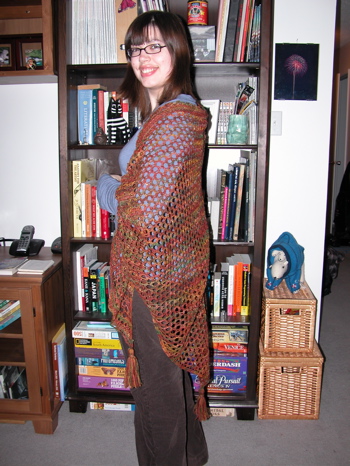
This is not actually a recent project but I decided to block it out yesterday and, given the yarn name, today seemed a goodday to post it. I usually call this my “dishcloth shawl” because the pattern is actually the first part of a free dishcloth pattern I got when I first started knitting. I made this a little over a year ago and sometimes use it to keep my shoulders warm at work. It’s more of a fishu than a shawl but it’s great for filling in the neckline of a shirt when the air is cold but you don’t want to wear a turtle neck.

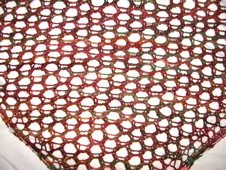
Since it is all garter stitch it had a kind of lumpy texture (see above) and I wanted to see how it would look blocked out flat. I gave it a good soak and a rinse and pinned it out on top of a sheet on the carpet. I think it responded very well. The stitches stretched out to make a clear lace pattern with large eyelets making a border down the sides. The texture of the yarn itself still shows very well (perhaps better) but the shawl has a smoother appearance and will lay flat on a surface, or my shoulders, instead of bunching up. It’s still more of a shawlette than a shawl but it grew almost 20 cm (8") in each direction.

The picture at the top is a curl of mohair (I think) that was sticking out of the shawl when I finished blocking. It reminds me of that perfect curl Superman always has in the middle of his forehead.
The Dishcloth Shawl
A simple shawl easily adapted to your materials, tools and preference. It is a garter stitch triangle formed with eyelet increases at the beginning of each row.
A simple shawl easily adapted to your materials, tools and preference. It is a garter stitch triangle formed with eyelet increases at the beginning of each row.
Materials
Yarn: Any you like.
Needles: Any size to suite your yarn and desired gauge.
Tapestry Needle
Gauge:
There is no set gauge for this pattern. Using the suggest needles for your yarn as a starting point you can experiment to achieve different effects. A tight gauge on smaller needles will produce a dense, solid fabric. A loose gauge on larger needles will produce a lacier shawl.
Terms:
K1fb: Knit into the front and back of a stitch to increase one.
YO: Yarn over. Between two stitches put the yarn around the right needle as though forming a stitch.
Directions:
Cast on 2 stitches.
Row 1: K1fb, K1fb; 4 sts
Row 2: K2, YO, Knit to end of row. 5 sts
Repeat Row 2 to desired size or until you have only enough yarn left to bind off.
Bind off top edge loosely.
Finishing:
Weave in yarn ends. Block your shawl as desired for an even finish. Lacy shawls can be blocked out tightly; denser shawls won't need as much stretching.